
Our troubleshooting guide covers the full decision tree for a door that won't close, including sensor and balance issues. This article focuses specifically on the off-track scenario, which is one of the more serious causes and deserves its own explanation.
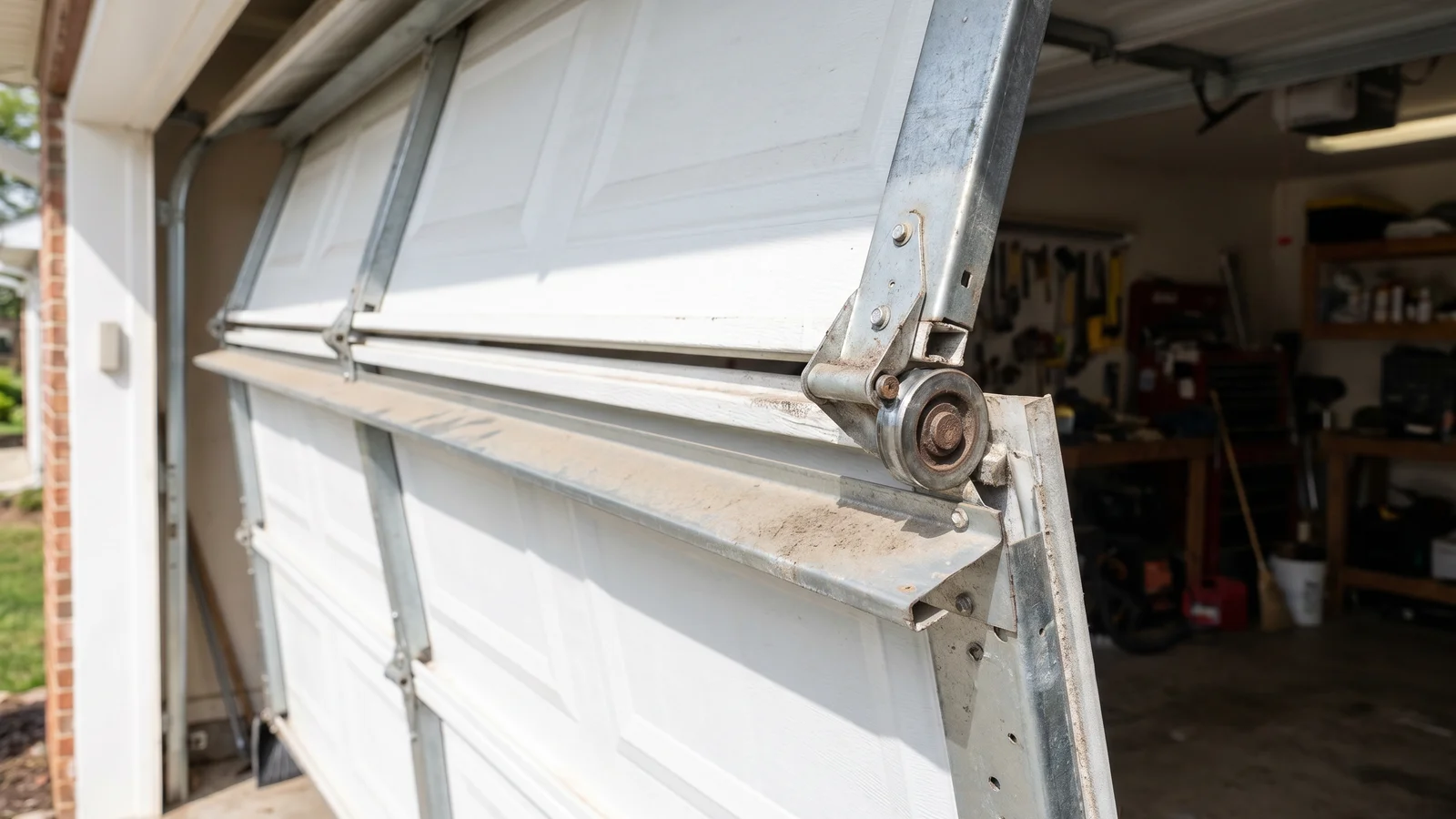
How to Tell If Your Door Is Actually Off Track
An off-track door is usually visually obvious: the door sits crooked, one corner may be noticeably lower than the other, or you can see a roller sitting outside the track's channel rather than inside it. This is different from a door that simply won't close due to a sensor or opener issue — an off-track door has a visible mechanical/structural problem, not just a control-system issue.
The Three Most Common Causes
- Vehicle or object impact — a car backing into the door, or a stored item falling against it, can knock rollers out of the track instantly
- A snapped cable — when one cable fails, that side of the door drops suddenly and unevenly, often pulling rollers out of alignment as it does
- Severely worn rollers — over years of use, worn rollers can develop enough play to eventually slip out of the track guide during normal operation, especially if the track itself has also drifted slightly out of alignment
Why This Isn't a Safe DIY Fix
An off-track door is frequently still under spring tension, even though it's visually stuck or crooked. Attempting to manually force the door back into the track risks sudden, uncontrolled movement — the door could shift further, a stressed cable could snap, or the spring could release unexpectedly. This is one of the clearest "stop and call a professional" situations in garage door repair, regardless of how simple the fix might look.
What Repair Actually Involves
Fixing an off-track door properly starts with the same diagnostic step every time: releasing spring tension safely before touching the track or rollers, since attempting realignment under load is exactly what makes this dangerous for untrained hands. From there, the technician inspects the track for bends or damage (a track knocked out of shape during the incident often needs straightening or replacement, not just realignment), checks all rollers for wear or damage that may have contributed to the failure, and only then re-seats the door and tests full-range operation before considering the job complete. What looks like a five-minute fix from the outside is usually a 45-90 minute job precisely because of this sequence.
What You Can Safely Do While Waiting for Service
Common Homeowner Mistakes
Attempting to manually force the door back into track alignment, continuing to press the opener remote repeatedly hoping it resolves itself (it won't, and can cause further damage), and not disconnecting the opener before attempting even basic visual inspection.